Hans Thoma (1839-1924)
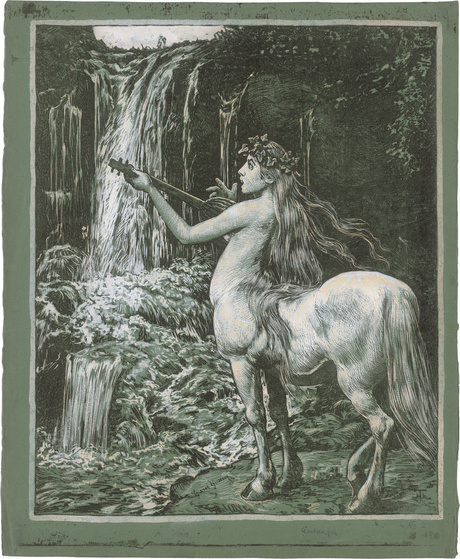
Female Centaur at the Waterfall [Centaurin am Wasserfall]
1892
tachograph print (Beringer 9) with highlights in white and ochre on green vellum paper
image 45,5 x 37,5 cm; sheet 50,6 x 41,3 cm
monogrammed and dated "HTH (18)92" in the plate bottom right
signed "Hans Thoma" in black pen within the image bottom center
inscribed "Centaurin" and "No 2" in pencil in margin lower right
The Daulton Collection
Magnificent print with the full margin in excellent condition.
Provenance:
The artist's estate [Aus dem Nachlass des Künstlers]
Collection Dr. Friedrich Blaue, Karlsruhe (son-in-law of the artist; stamp verso, not in Lugt)
H. W. Fichter Kunsthandel, Frankfurt a. M.
Private collection Hesse
Publication History of The Daulton Collection's unique impression of this print:
H.W. Fichter Kunsthandel, Hans Thoma, Experimente in Druck und Farbe (Frankfurt a.M., 2019), Cat. No. 6.
Felix Reusse, ed., Hans Thoma: Zwischen Poesie und Wirklichkeit (Petersberg: Michael Imhof Verlag, 2024) (exhibition catalogue, Staedtische Museen Freiburg), fig. 8 at pg. 162.
Discussion:
"Hans Thoma only discovered printmaking for himself when he was already a mature and established artist. This new fascination with the medium originated in a sales advertisement for a so-called 'tachograph' that he found by chance. With this, it was now possible to print lithographs by hand with little effort, not - as usual - reversed, but correctly, and thus to convey the artistic impression more directly. Thoma subsequently experimented with the new technology and its artistic possibilities and created a number of print and color samples, which he always printed by hand and usually only in 3 to 10 copies. The present copy, with its hand-rework, is a unique piece that remained in the family's possession long after the artist's death." B
["Hans Thoma entdeckte die Druckgraphik erst für sich als er bereits ein gereifter und arrivierter Künstler war. Seinen Ursprung hatte diese neue Faszination mit dem Medium in einer zufällig gefundenen Verkaufsanzeige für einen sogenannten "Tachographen". Mit diesem war es nun möglich, Lithographien mit geringem Aufwand von Hand nicht - wie üblich - seitenverkehrt, sondern seitenrichtig zu drucken und so den künstlerischen Eindruck unmittelbarer zu übertragen. Thoma experimentierte in der Folge mit der neuen Technik und ihren künstlerischen Möglichkeiten und schuf eine Zahl von Druck- und Farbproben, die er stets von Hand und meist nur in 3 bis 10 Exemplaren abzog. Bei dem vorliegenden Exemplar handelt es sich dabei mit seiner Überarbeitung von Hand um ein Unikat, dass sich noch lange nach dem Tod des Künstlers im Besitz der Familie befunden hat." B]
"Among the terrestrial hybrids, Thoma also depicted centaurs, creatures with a human upper body and a horse's body. It is noteworthy that, contrary to common tradition, Thoma presents mainly female figures. In the print ‘Centaurin am Wasserfal’ [‘Female Centaur at Waterfall’] (Fig. 8), he creates an idyllic scene: At the edge of a cascade, a youthful human/horse figure plays music, her gaze fixed on the waterfall. Completely in harmony with her surroundings, the centaur plays her lute and, with her mouth wide open, sings an ode to the forces of nature. Resembling the flow of the waterfall, her long hair, crowned by a wreath of vine leaves, falls onto her muscular horse body." Reusse at pgs. 161-162 (translated from the original German-language text).
Provenance: From the artist's estate.
Collection Dr. Friedrich Blaue, Karlsruhe (son-in-law of the artist; stamp verso, not in Lugt).
H. W. Fichter Kunsthandel, Frankfurt a. M.
Private collection Hesse.
Provenance: From the artist's estate.
Collection Dr. Friedrich Blaue, Karlsruhe (son-in-law of the artist; stamp verso, not in Lugt).
H. W. Fichter Kunsthandel, Frankfurt a. M.
Private collection Hesse.