The Daulton Collection owns an extraordinary group of 223 drawings, created between 1921 and 1928, that are studies for Sigmund Lipinsky's magnum opus, a portfolio of eight etchings, published in 1929: Radierte Bilder zu Homer's Odyssee [Etched Pictures of Homer's Odyssey]. The Daulton Collection also owns a proof set of the entire portfolio of etchings as published (see the previous entry on this website). The drawings mostly consist of pencil studies on drawing paper; however, there are also pen sketches and washed brush drawings, outlines scratched on transparent foil, studies on tracing paper, chalk drawings heightened with white, works made with colored chalk, a few gouaches, and some watercolored sheets on differently tinted paper. The dimensions of the drawings range from 15,1 x 10 cm to 48 x 34 cm. Some of the drawings are signed (or monogrammed or initialed), dated, and/or titled. The provenance of the drawings is the artist's estate, in his family's possession since his death in 1940.
Discussion:
"From 1892 to 1896, Sigmund Lipinsky attended the Berlin Academy of Fine Arts, where he was initially taught by Paul Meyerheim and later as a master student by Anton von Werner. Still under the influence of the latter, Lipinsky won the 1899 competition to design frescoes for the von Moltke family's castle in Kreisau in Silesia and was awarded the Grand State Prize, which came with a three-year scholarship to Rome. From 1902, Lipinsky settled in the Eternal City for the rest of his life. In 1905, he joined the local German Artists' Association. He made friends with other German-Roman artists, including Otto Greiner and Max Klinger in particular, and, turning to symbolism, increasingly sought motifs from mythology. He painted in watercolor and oil, but from 1911 onwards devoted himself more to etching and copperplate engraving and designed a large number of bookplates and letterheads. During the war years he had to leave Italy and moved to Munich with his second wife and three children. Here he came into contact with the artists of the Munich New Secession, the New Artists' Association, and the Berlin New Secession. In 1919 he and his family finally returned to Rome. He founded the Sigmund Lipinsky Academy in the legendary artists' street Via Margutta, a painting and drawing school near the Spanish Steps, the epicenter of the German-speaking artists' colony. His main priority was drawing from a live model, especially the female nude: '[...] the naturalism of his nudes is hard to beat, and one can say that since the death of Greiner, to whom Lipinsky was close, few other nude artists can stand alongside him.' (Richard Braungart: Deutsche Exlibris und andere Kleingraphik der Gegenwart, Munich 1922). His interest in human anatomy culminated in 1931 in the publication of the 'Manuale Anatomico. Per la Studio Artistico del corpo umano,' a work for artists with 25 plates and appendixes of anatomical names." B
"The eight-part series of etchings on Homer's Odyssey, created between 1923 and 1929, is considered one of Lipinsky's greatest artistic achievements as an etcher. Here is the extraordinary portfolio from Lipinsky's estate with well over 200 drawings for this project, which shows his meticulous approach to the subject and also provides many insights into the world of ideas and forms of the planned and unfinished etchings. These include an unrealized title page and etchings of the 'Sirens,' 'Polyphemus,' 'Odysseus in the Underworld,' 'Odysseus Tells,' 'The Homecoming,' 'At Telemachus's,' 'At the Shepherds',' 'The Mockery of Odysseus' and the final page 'Odysseus and Penelope.' In addition, a unique compendium of the functions and possibilities of the medium of hand drawing is also gathered here: early, first sketches of ideas and drafts of compositions; nude, posture, movement, and motif studies, designs for draperies and ornaments, studies of Etruscan ceramics and ancient architecture, and occasionally animal and plant studies, writing samples for the title page and the artist's monogram, and finally portraits, some with the names and addresses of the models. Some sheets are dated and monogrammed, some squared for transfer. This variety of functions of the drawing is also reflected in the wealth of drawing materials and paper. Although most of them are pencil studies on drawing paper, there are also pen sketches and washed brush drawings, outlines scratched on transparent foil, studies on tracing paper, chalk drawings heightened with white and works made with colored chalk, and a few gouaches and some watercolored sheets on differently tinted paper. All in all, a rich treasure that provides deep insights into Sigmund Lipinsky's working methods over a period of six years." B
German-language original source:
"Von 1892 bis 1896 besucht Sigmund Lipinsky die Berliner Akademie der bildenden Künste, an der er zunächst von Paul Meyerheim, später dann als Meisterschüler von Anton von Werner unterrichtet wird. Noch ganz unter dessen Einfluss gewinnt Lipinsky 1899 den Wettbewerb für die Gestaltung von Fresken für das Schloss der Familie von Moltke in Kreisau in Schlesien und erhält dafür den Großen Staatspreis, der mit einem dreijährigen Rom-Stipendium verbunden ist. Ab 1902 lässt sich Lipinsky für den Rest seines Lebens in der Ewigen Stadt nieder. 1905 tritt er dem dortigen Deutschen Künstlerverein bei. Er schließt Freundschaft mit anderen Deutschrömern, darunter insbesonders mit Otto Greiner und Max Klinger und sucht, unter Hinwendung zum Symbolismus, zunehmend Motive aus der Mythologie. Er malt in Aquarell und Öl, widmet sich aber ab 1911 vermehrt der Radierung und dem Kupferstich und entwirft eine große Anzahl von Exlibris und Briefköpfen.
Während der Weltkriegsjahre muss er Italien verlassen und zieht mit seiner zweiten Frau und den drei Kindern nach München. Hier kommt er in Kontakt mit den Künstlern der Münchner Neuen Secession, der Neuen Künstlervereinigung und der Berliner Neuen Secession. 1919 schließlich kehrt er mit der Familie endgültig nach Rom zurück. Er gründet in der legendären Künstlerstraße Via Margutta die Sigmund-Lipinsky-Akademie, eine Mal- und Zeichenschule in der Nähe der Spanischen Treppe, dem Epizentrum der deutschsprachigen Künstlerkolonie. An erster Stelle steht für ihn das Zeichnen nach dem lebenden Modell, insbesondere dem weiblichen Akt: „[…] der Naturalismus seiner Akte ist kaum zu überbieten, und man kann schon sagen, daß seit dem Tode Greiners, dem Lipinsky nahegestanden hat, nur wenige als Aktzeichner neben ihm bestehen dürften.“ (Richard Braungart: Deutsche Exlibris und andere Kleingraphik der Gegenwart, München 1922). Sein Interesse für die menschliche Anatomie gipfelt 1931 in der Veröffentlichung des „Manuale Anatomico. Per la Studio Artistico del corpo umano“, ein Werk für Künstler mit 25 Bildtafeln und Anhängen von anatomischen Namen." B
"Die zwischen 1923 und 1929 entstandene achtteilige Radierfolge zu Homers Odyssee gilt als eine der höchsten künstlerischen Leistungen Lipinskys als Radierer. Hier nun liegt aus dem Nachlass Lipinskys die außergewöhnliche Mappe mit weit über 200 Zeichnungen für dieses Projekt vor, die seine akribische Herangehensweise an das Thema, und auch viele Einblicke in die Ideen- und Formenwelt der geplanten und nicht vollendeten Radierungen gewährt. Zu diesen zählen ein nicht realisiertes Titelblatt sowie Radierungen zu den "Sirenen", zu "Polyphem", "Odysseus in der Unterwelt", "Odysseus erzählt", "Die Heimkehr", "Bei Telemachos", "Bei den Hirten", "Die Verhöhnung des Odysseus" und das Schlussblatt "Odysseus und Penelope". Darüberhinaus ist hier aber auch ein einmaliges Kompendium der Funktionen und Möglichkeiten des Mediums der Handzeichnung versammelt: Zu finden sind frühe, erste Ideenskizzen und Kompositionsentwürfe; Akt-, Haltungs-, Bewegungs- und Motivstudien, Entwürfe für Draperien und Ornamente, Studien etruskischer Keramik und antiker Architektur, vereinzelt auch Tier- und Pflanzenstudien, Schriftproben für das Titelblatt und das Künstlermonogramm, schließlich auch Porträts, teils mit Namen und Adresse der Modelle. Manche Blätter sind datiert und monogrammiert, teils auch zur Übertragung quadriert. Diese Funktionsvielfalt der Zeichnung spiegelt sich auch im Reichtum der Zeichenmittel und der Papiere wider. Zwar handelt es sich zum größten Teil um Bleistiftstudien auf Zeichenpapier, es finden sich aber auch Federskizzen und lavierte Pinselzeichnungen, auf durchsichtige Folie geritzte Umrisse, Studien auf Transparentpapier, weiß gehöhte Kreidezeichnungen und mit Farbkreiden ausgeführte Arbeiten, vereinzelt auch Gouachen und teilweise aquarellierte Blätter auf unterschiedlich getönten Papieren. Insgesamt ein reicher Schatz, der tiefe Einblicke in Sigmund Lipinskys Arbeitsweise über einen Zeitraum von sechs Jahren erlaubt." B
"The collection is a unique and extraordinarily full
immersion in the creative process of one of the leading German symbolist
artists working in Italy at the turn of the 20th century.” EvB
|
Sigmund Lipinsky (1873 Graudenz-1940 Rome)
Study for Odysseus Slaying the Suitors
1921
pencil on paper with white heightening
signed, inscribed, and dated in pencil lower right: "S.Lipinsky Roma 1921."
The Daulton Collection
Provenance: the artist's estate, in his family's possession since his death in 1940.
Publication History of this Drawing:
Emanuele Bardazzi, Sogni d'Arcadia / Arkadische Traümerei: Sigmund Lipinsky e gli ultimi tedeschi-romani [Dreams of Arcadia: Sigmund Lipinsky and the last German-Romans] (Florence: Edizioni Polistampa / Leonardo Libri, 2025), illustrated at fig. 18, pg. 24.
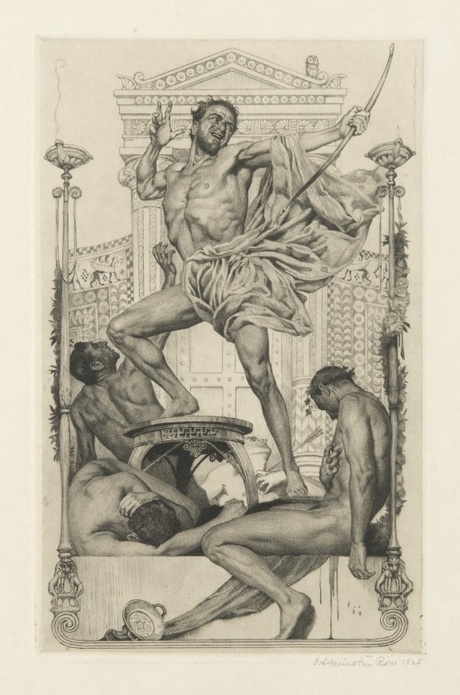
This is the finished etching:
|
Sigmund Lipinsky (1873 Graudenz-1940 Rome) Odysseus Slaying the Suitors 1925 etching, burin, and drypoint signed and inscribed in pencil lower right: "S.Lipinsky Rom 1925." proof impression ahead of the numbered edition of 50 The Daulton Collection
|
Sigmund Lipinsky (1873 Graudenz-1940 Rome)
Study of Hermes for the etching Council of the Gods
1923
pencil on paper
dated and initialed in pencil lower right: "20. V. 23. S.L."
The Daulton Collection
Provenance: the artist's estate, in his family's possession since his death in 1940.
Publication History of this Drawing:
Emanuele Bardazzi, Sogni d'Arcadia / Arkadische Traümerei: Sigmund Lipinsky e gli ultimi tedeschi-romani [Dreams of Arcadia: Sigmund Lipinsky and the last German-Romans] (Florence: Edizioni Polistampa / Leonardo Libri, 2025), illustrated at fig. 19, pg. 25.
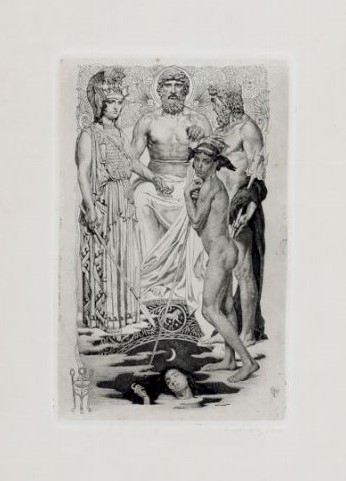
This is the finished etching:
|
Sigmund Lipinsky (1873 Graudenz-1940 Rome) The Council of the Gods 1923 etching and drypoint 21,8 x 13,8 cm (image) signed and inscribed in pencil lower right: "S.Lipinsky Rom" proof impression ahead of the numbered edition of 50 (60?)
The Daulton Collection
sheet 1 from the portfolio Radierte Bilder zu Homer's Odyssee
|
Sigmund Lipinsky (1873 Graudenz-1940 Rome) Study of the enchantress Circe holding a bowl of potions circa 1923 pencil on paper inscribed "I" upper right corner
The Daulton Collection
a study for Plate V of the etchings portfolio Radierte Bilder zu Homer's Odyssee
Provenance:
the artist's estate, in his family's possession since his death in 1940
acquired by The Daulton Collection in 2024
|
Sigmund Lipinsky (1873 Graudenz-1940 Rome) Study of Odysseus beseeching Nausicaa for assistance circa 1928 pencil with white heightening on paper
The Daulton Collection
a study for Plate VII of the etchings portfolio Radierte Bilder zu Homer's Odyssee
Provenance:
the artist's estate, in his family's possession since his death in 1940
acquired by The Daulton Collection in 2024
|
Sigmund Lipinsky (1873 Graudenz-1940 Rome)
Study of Penelope with Two Maids
circa 1927
pencil on paper
titled within the image: "PENELOPE"
The Daulton Collection
a study for Plate II of the etchings portfolio Radierte Bilder zu Homer's Odyssee
Provenance:
the artist's estate, in his family's possession since his death in 1940
acquired by The Daulton Collection in 2024
|
Sigmund Lipinsky (1873 Graudenz-1940 Rome)
Study of the Goddess Calypso
circa 1923
pencil on paper
upper right corner of sheet inscribed in pencil with the name and address of the artist's model: "Margarethe [?] [indecipherable surname] Via Crescenzio 103 [in Rome] [indecipherable]"
The Daulton Collection
a study for Plate III of the etchings portfolio Radierte Bilder zu Homer's Odyssee
Provenance:
the artist's estate, in his family's possession since his death in 1940
acquired by The Daulton Collection in 2024
|
|
Contact:
The Daulton Collection thedaultoncollection@outlook.com
|
|
|